How to Dress Stylishly Over 40 Without Looking Boring
How to Dress Stylishly Over 40 Without Looking Boring, Dressing stylishly over 40 does not mean wearing plain outfits every day. It also does not mean chasing every trend. The secret is finding a balance between timeless pieces and interesting details.
Many women over 40 want to look polished, modern, and age-appropriate without feeling dull. The good news is that classic style can still be exciting. With the right colors, shapes, accessories, and outfit combinations, you can create looks that feel fresh and confident.
Q&A
Yes. Choose trends that fit your personal style. You do not need to wear every trend to look current.
Mix classic pieces with modern details, such as updated shoes, current denim, or a fresh color.
Absolutely. Choose jeans that fit well, such as straight-leg, wide-leg, bootcut, or dark denim.
Add accessories, texture, color, or one statement piece.
Wear good shoes, add jewelry, and choose clothes that fit well.
Why Style Over 40 Should Never Feel Boring
By the time you are over 40, you may have a clearer idea of what you like. That is a good thing. Your wardrobe should reflect your personality, not hide it.
Looking stylish over 40 is not about dressing loudly. It is about adding intention. A simple outfit can become beautiful with a great bag, modern shoes, a flattering blazer, or a bold piece of jewelry.
Start With Better Basics
Boring style often starts with basics that feel tired, stretched out, or poorly fitted. Upgrade your everyday pieces first.
Choose quality tees, soft sweaters, crisp shirts, flattering jeans, tailored trousers, and comfortable shoes. When your basics look good, your outfits immediately feel more stylish.
Add One Statement Piece
A statement piece keeps an outfit interesting. It can be a printed blouse, a colorful blazer, a textured handbag, bold sunglasses, metallic shoes, or a beautiful coat.
The trick is to wear one standout item at a time. This keeps the outfit polished instead of overwhelming.
Play With Color
Neutrals are timeless, but color can make your style feel fresh. Try soft pink, olive green, navy, burgundy, butter yellow, cobalt blue, red, or chocolate brown.
You can start small with a colorful bag, scarf, blouse, or shoe. If you prefer a softer look, try muted colors instead of bright shades.
Use Texture to Add Interest
Texture is one of the easiest ways to make an outfit look expensive. Try satin, linen, denim, suede, leather, cashmere, ribbed knits, tweed, or lace.
A simple cream sweater with a satin skirt looks more interesting than a plain top and basic pants. A leather jacket over jeans adds edge without needing a loud print.
Update Your Shoes
Shoes can make an outfit feel current or outdated. Comfortable shoes can still be stylish. Try loafers, ballet flats, sleek sneakers, ankle boots, block heels, platform sandals, or metallic flats.
A modern shoe can completely change the mood of an outfit.
Choose Flattering Layers
Layers help create shape and polish. A blazer, trench coat, denim jacket, cardigan, cropped jacket, or long coat can make a basic outfit feel intentional.
For example, jeans and a tee may feel simple, but add a beige blazer, gold jewelry, and loafers, and the outfit becomes chic.
20 Chic Fashion Ideas for Women Over 40
Summer Sandals That Are Stylish and Comfortable
10 Outfit Ideas That Are Stylish, Not Boring
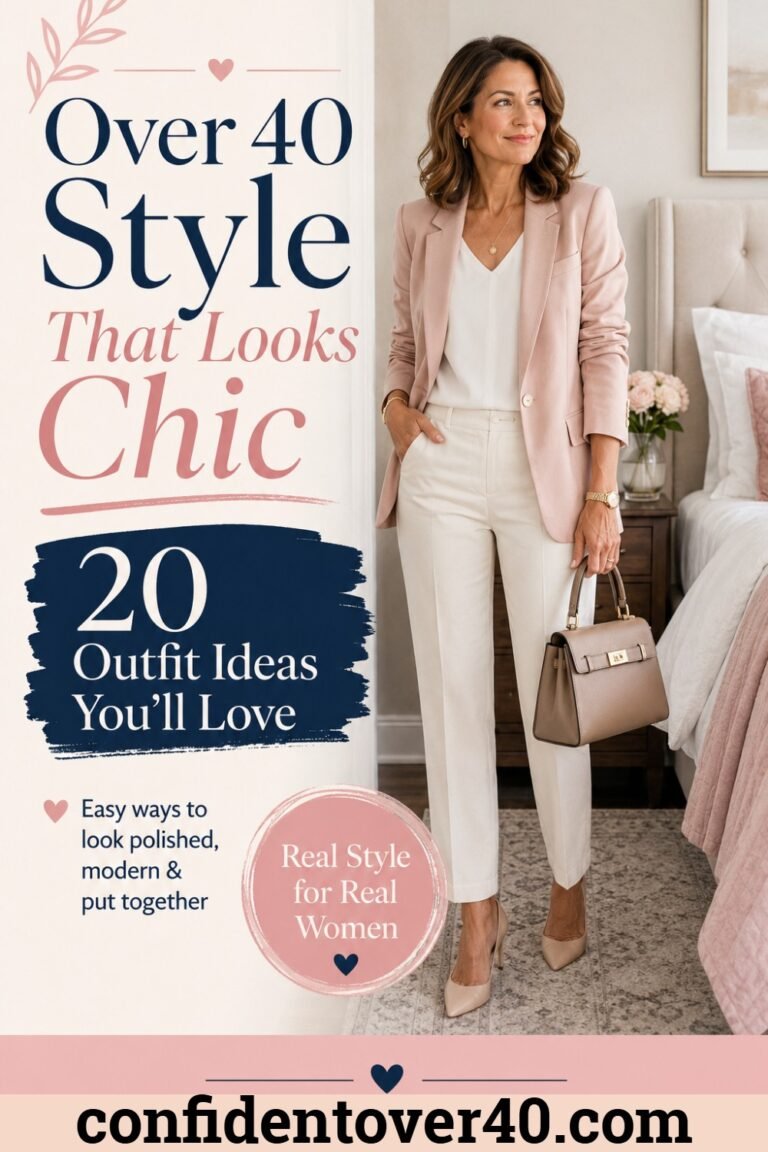
1. Cream Blazer, White Tee, and Jeans
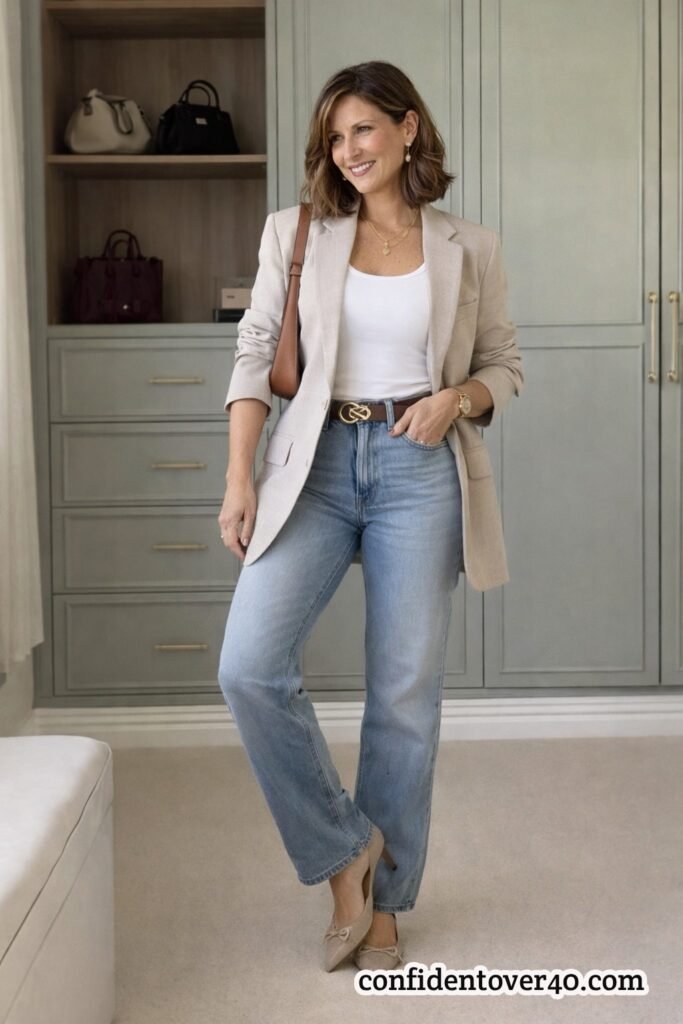
Classic, simple, and polished. Add a structured handbag and loafers.
(How to avoid the “Flat Pancake” look)
Since a cream blazer and jeans are both mid-weight fabrics, you need to create contrast.
The Shoulder: Opt for a blazer with a slight shoulder pad or a tailored, structured shoulder. This creates a strong “T” shape on top, making your waist look smaller by comparison.
The Sleeve: Push the sleeves up to just below your elbow (the “French roll” for blazers). This breaks up the cream color and adds a relaxed, billowy puff around your forearms.
The Jean: Go for a ’90s Straight or Wide-Leg cut. If your blazer is structured, a wide leg balances the shoulders perfectly. Avoid skinny jeans here—they make the blazer look like a bathrobe.
The Shoe: A lug-sole loafer (thick, chunky rubber sole) adds visual weight to your feet, anchoring the volume of the wide-leg jeans so you don’t look top-heavy.
2. The “How-To” Wear Guide (Step-by-Step)
The Tuck: Do not just leave the white tee hanging out. Do a “French Tuck”—tuck just the front center of the tee into the waistband of your jeans, leaving the back and sides loose. This defines your natural waist without looking stuffy.
The Collar Pop: Take the back collar of the white tee and pull it up so it sits just slightly higher than the back collar of the blazer. This gives a cool, layered street-style vibe.
The Cuff: Cuff your jeans once (a 1.5-inch fold) so they hit right at the ankle bone. This creates a visual “break” between the denim and the loafer, preventing the outfit from looking like a solid block of fabric.
The Bag Hold: Carry your structured handbag in the crook of your elbow (not on your shoulder). This cinches the blazer slightly at your side, creating an hourglass silhouette when you walk.
3. Pro Styling Tips (The “It” Factor)
The “No-Bra” Rule (Optional): If you are comfortable, wear the white tee without a bra, or with a nude pasty. The slight natural drape of the cotton against the rigid blazer reads as incredibly chic, rather than matronly.
The Lipstick Cheat: Cream blazers can wash out pale skin. Always add a brick-red or berry-toned lipstick. It acts as the “pop” that makes the cream look expensive rather than clinical.
The Belt Dilemma: Do not belt the blazer. If you want waist definition, wear a thin brown leather belt over your jeans, but let the blazer hang completely open over it.
2. Satin Skirt and Soft Sweater
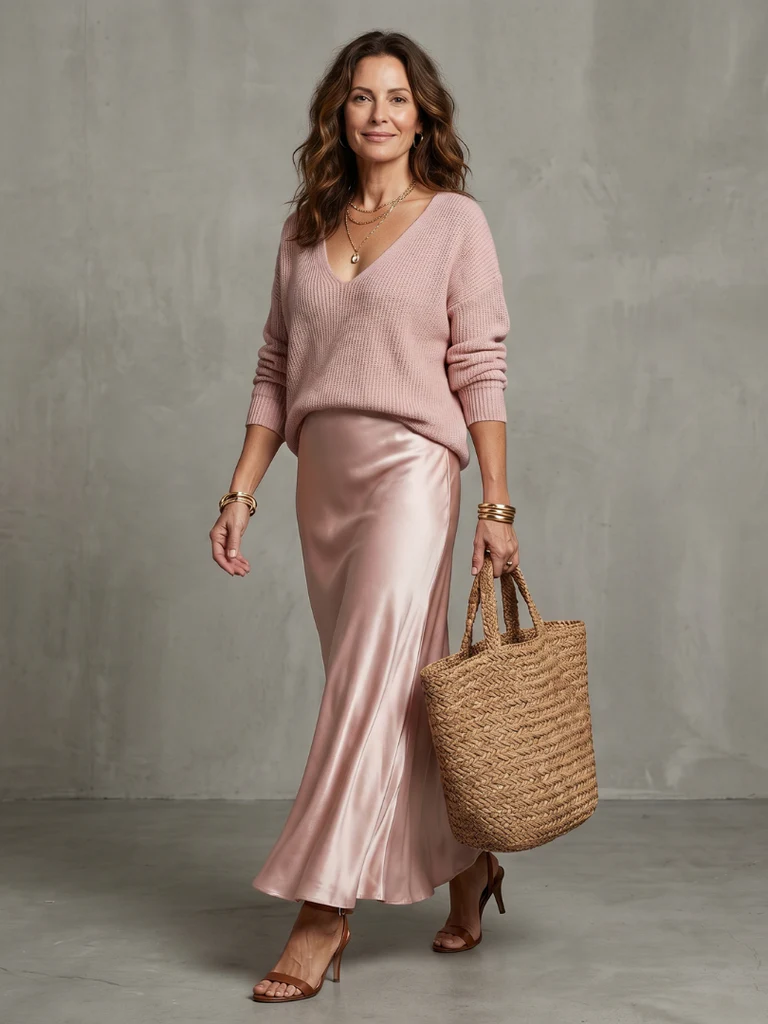
This look feels feminine and comfortable. Add low heels or ankle boots.
(Creating an Hourglass from Soft Fabrics)
Because both fabrics are fluid, you have to engineer the silhouette. You are not looking for stiff puff; you are looking for controlled flow.
The Sweater: Go oversized or balloon-sleeved. The torso should have at least 4–6 inches of ease (breathing room). The volume on top makes your waist look impossibly small when contrasted with the skirt’s drape. Crucial tip: The hem of the sweater should hit right at your hip bone—any longer and it eats your torso; any shorter and it looks like a crop-top from 2015.
The Sleeve: If your sweater has long sleeves, push them up to the mid-forearm and let the excess fabric bunch there. This creates a “muffin” volume at your wrists that balances the wide expanse of the skirt.
The Skirt: Do not wear a pencil or bodycon satin skirt here. You need an A-line, Bias-Cut, or Pleated Midi. The bias cut is the holy grail—it hugs your hips just enough before flaring out into a soft, liquid puddle at your shins, giving maximum movement volume.
2. The “How-To” Wear Guide (Step-by-Step)
The Tuck (Do NOT fully tuck): Satin is unforgiving with bunching. Instead, do the “Half-Tuck”—tuck only the side seam of the sweater into the waistband of the skirt on your left or right hip. Leave the front and back completely loose. This creates an asymmetrical drape that adds diagonal volume and visually lengthens your legs.
The Waist Definition: Because you aren’t fully tucking, add a thin leather belt (in a contrasting color like tan or black) worn loosely over the sweater, sitting directly on your natural waist. Cinch it just one notch—it should hold the sweater against your body without digging in.
The Shoe Rule: The skirt’s hem should hit mid-calf (the widest part of your lower leg). To avoid looking stump-ish, your shoe must have a pointed toe—this extends your visual leg line through the toe. If wearing flats, choose a pointed ballet flat; if heels, a pointed kitten heel.
The Walk-Test: Satin skirts ride up when you walk. Before you leave the house, do 10 high-knee marches. If the skirt climbs more than 2 inches, you need a slip dress worn underneath it (nylon, not cotton) to create friction so it stays anchored at your waist.
3. Pro Styling Tips (The “It” Factor)
The Texture Clash: The biggest mistake is wearing a knit sweater with a smooth satin. You need ribbing, cable-knit, or angora/mohair fuzz. The fuzzier the sweater, the shinier the satin looks by comparison. If both are smooth, the outfit falls flat.
The “Cold Shoulder” Styling: Gently pull the neckline of your sweater off one shoulder (just an inch). The exposed skin acts as a “visual pause” between the high neck of the sweater and the flow of the skirt, making your neck look longer.
The Scent/Static Hack: Satin + wool = static cling. Rub a dryer sheet over the inside of the skirt and your tights/pants before you put it on. Alternatively, spray a light mist of hairspray on the inside of the skirt—the polymer stops the static instantly.
The Day-to-Night Flip: For day, wear chunky white sneakers (the chunky sole gives the skirt volume). For night, swap to strappy mules—the open back breaks up the long column of fabric.
3. Printed Blouse and Neutral Trousers
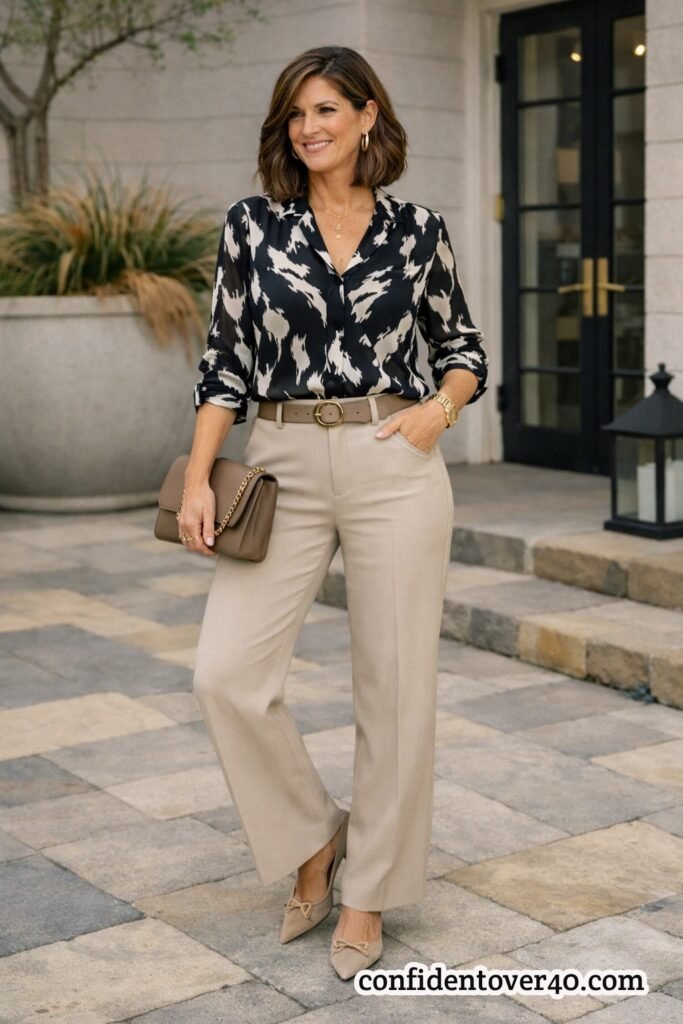
The print adds personality, while the trousers keep it classy.
(Architecture over Flow)
Unlike the previous two outfits (which relied on soft drape), this look needs structure and sharp lines to keep the print from looking messy.
The Trouser: This is where ALL your volume lives. Absolutely do not wear skinny or straight-leg trousers. You need a Wide-Leg, Palazzo, or Tailored Culotte that skims the floor. The volume should be so generous that the fabric swings when you walk. A pleated-front trouser is your best friend—the pleats act as built-in volume that drapes outward from your hip bone, creating a statuesque silhouette.
The Blouse: Tuck it in. All of it. No half-tucks, no French tucks. A printed blouse needs a clean, crisp tuck into high-waisted trousers to create a defined waistline. The volume of the trousers will balloon out from that tucked-in waist, giving you an exaggerated hourglass or column shape.
The Sleeve: If your blouse has a long sleeve, roll it to just below the elbow (a clean, military-style roll, not a messy push). If it has a puff or bishop sleeve, leave it alone—that puff acts as upper-body volume to counterbalance the wide-leg trousers.
The Shoe: Because the trousers are wide, you must wear a shoe with a heel (at least 2 inches). A block heel, kitten heel, or slim stiletto works. The heel lifts the fabric off the ground, allowing the volume to cascade rather than puddle. If you wear flats, the trousers will drag and look sloppy, killing all the volume.
2. The “How-To” Wear Guide (Step-by-Step)
The Tuck & Smooth: Tuck the blouse in, then do the “Sit-Down Test”—sit in a chair, stand up, and smooth the fabric. Pull about 1 inch of excess blouse fabric up out of the waistband so it billows slightly over the waistline. This prevents the dreaded “tucked-in sausage” look and gives a soft, blouson volume at your midsection.
The Sleeve Roll (If applicable): Fold the cuff back once, then fold again to mid-forearm. Push the rolled fabric up slightly so it bunches at the inner elbow. This creates an angular, sculpted volume that contrasts beautifully with the flowing trousers.
The Belt Hack: If your trousers have belt loops, add a contrasting belt (think tortoiseshell, leopard-print, or a chunky gold chain belt). Wear it loose—one finger should fit between the belt and your waist. This adds a horizontal line that anchors the busy print and stops the wide trousers from overwhelming your frame.
The Shoe Peek: Your trousers should hit right at the top of your foot, just brushing the floor. You should just see the tip of your pointed-toe heel peeking out when you stand still. When you walk, the heel should flash in and out of view—that’s the perfect length.
3. Pro Styling Tips (The “It” Factor)
The Print Scale Rule: If you are petite, choose a small, dense print (polka dots, micro-floral, pinstripe). If you are tall or have a broad frame, choose a large, abstract, or oversized print (big botanicals, wide stripes). The print must match your body’s canvas—otherwise, it wears you, not the other way around.
The “Neutral” Choice: Your “neutral” trousers don’t have to be beige or black. Think Camel, Olive Green, Charcoal Grey, or Navy. These act as dark/earthy anchors for bright prints. If your blouse is black-and-white, wear Camel trousers—the warmth of the camel makes the monochrome print sing.
The Collar Pop: If your blouse has a collar, pop the back collar up just slightly, leaving the front lapels flat. This gives a subtle, rebellious edge to an otherwise polished silhouette.
The Hard/Soft Mix: Printed blouses are soft and fluid. Your accessories must be hard and structured—think a boxy top-handle bag, rigid cuffs, or a geometric watch. This contrast is what elevates the outfit from “day-drinking” to “creative director.”
The Jewelry Edit: Skip necklaces entirely. The print is your neckline accessory. Instead, wear statement earrings (chunky resin hoops, sculptural silver, or tassels) that pull a color directly from the blouse’s print.
4. Wide-Leg Jeans and a Fitted Knit Top
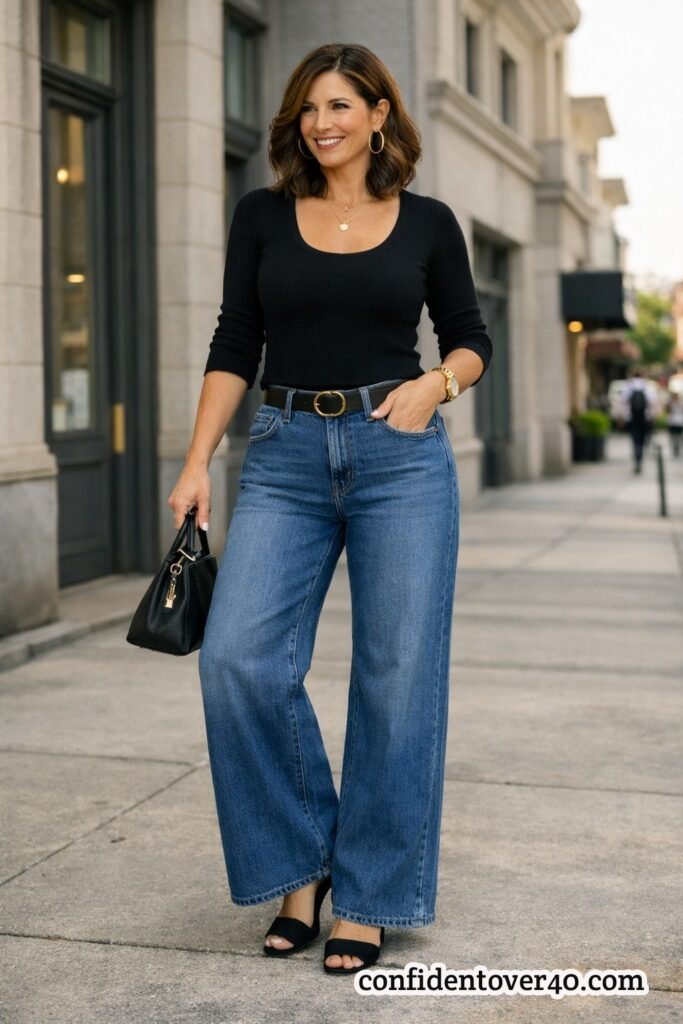
Modern denim instantly refreshes your style.
5. Black Dress and Statement Earrings
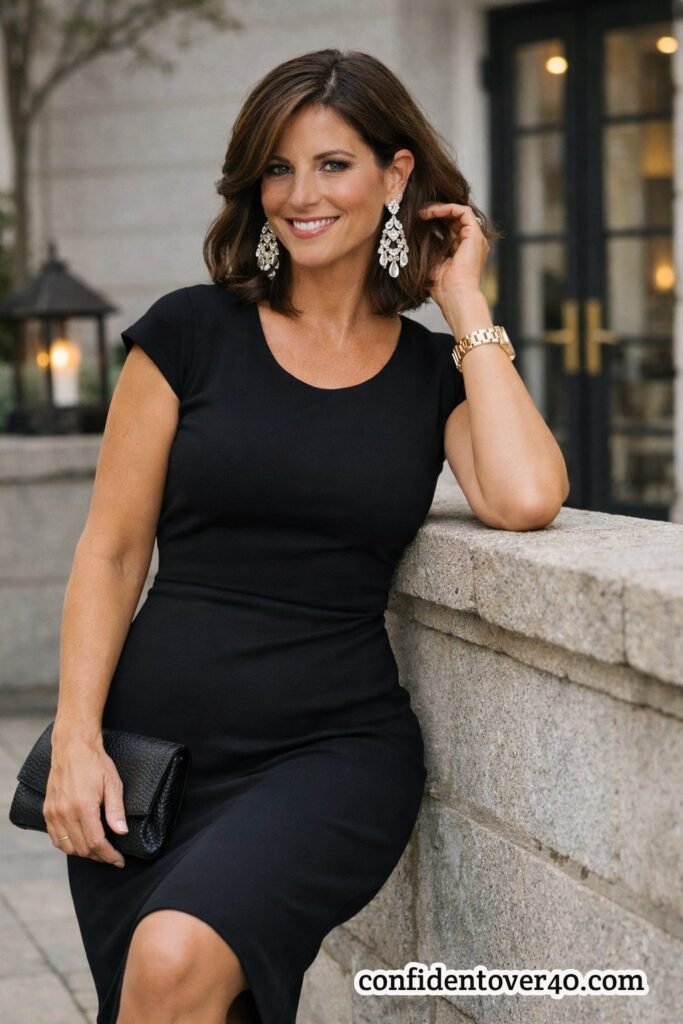
A simple black dress becomes evening-ready with bold jewelry.
6. White Jeans and a Colorful Button-Down Shirt
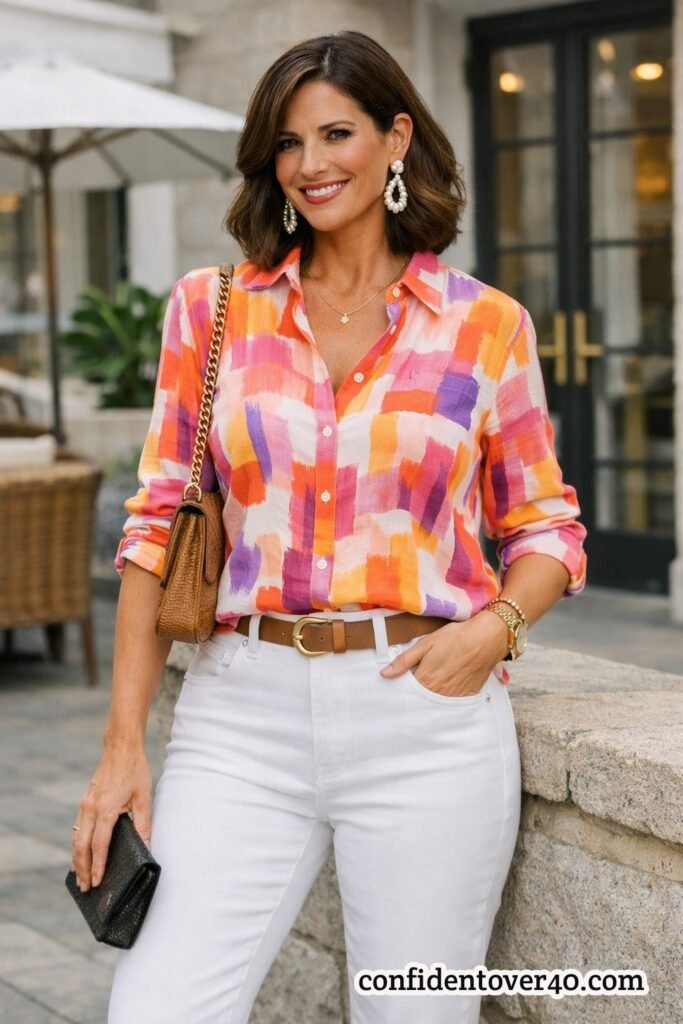
Fresh, bright, and perfect for spring or summer.
7. Leather Jacket, Tee, and Straight-Leg Jeans
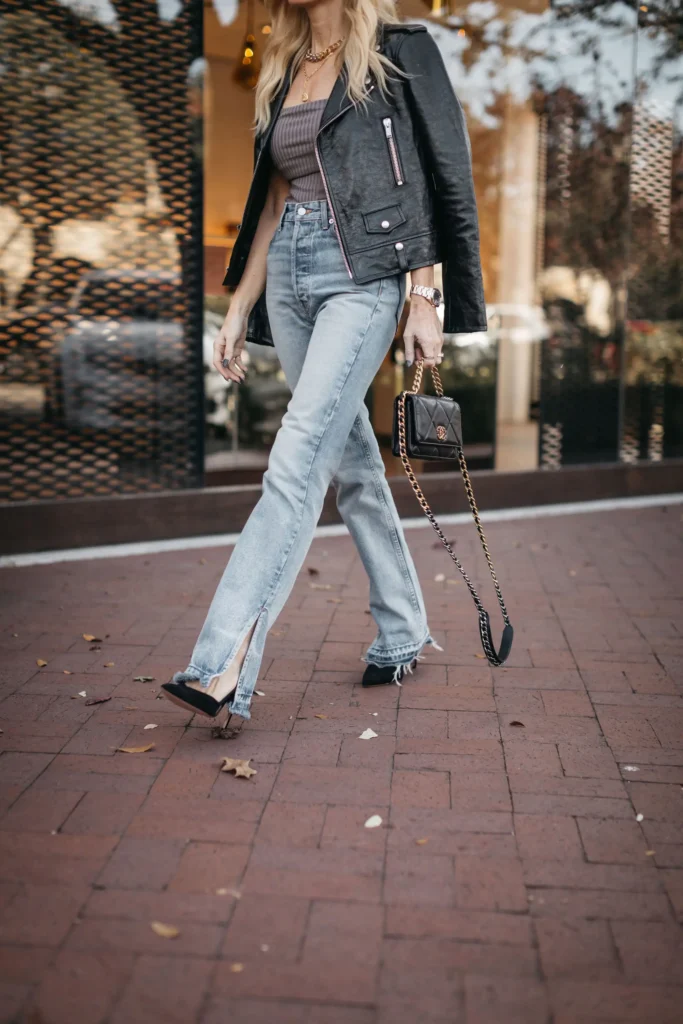
A little edgy but still wearable.
8. Trench Coat, Loafers, and Dark Denim
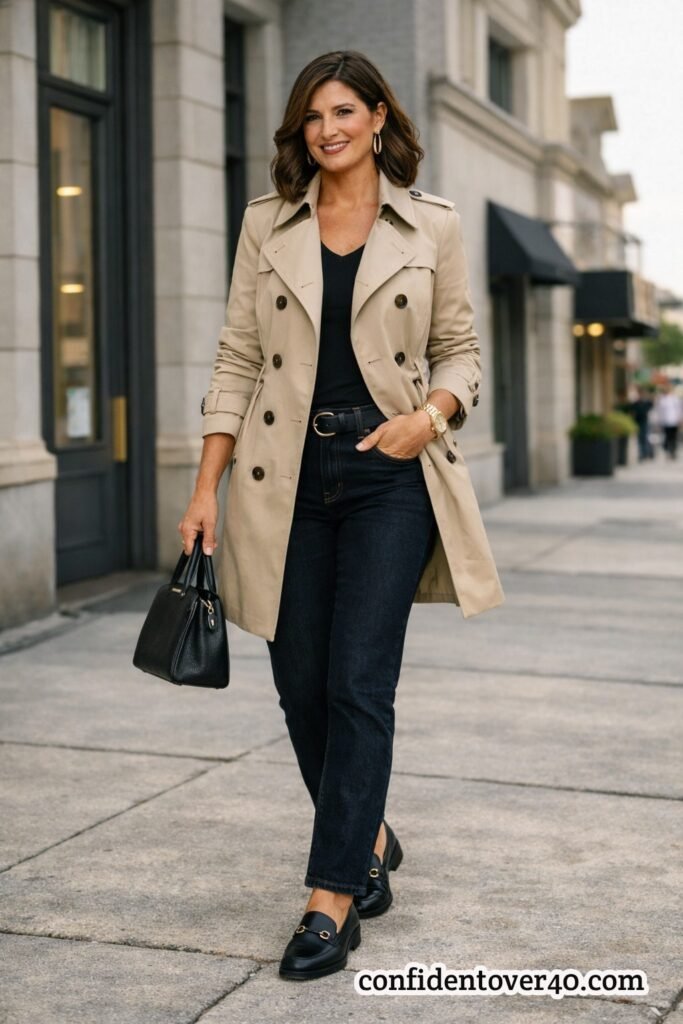
Timeless, polished, and perfect for everyday wear.
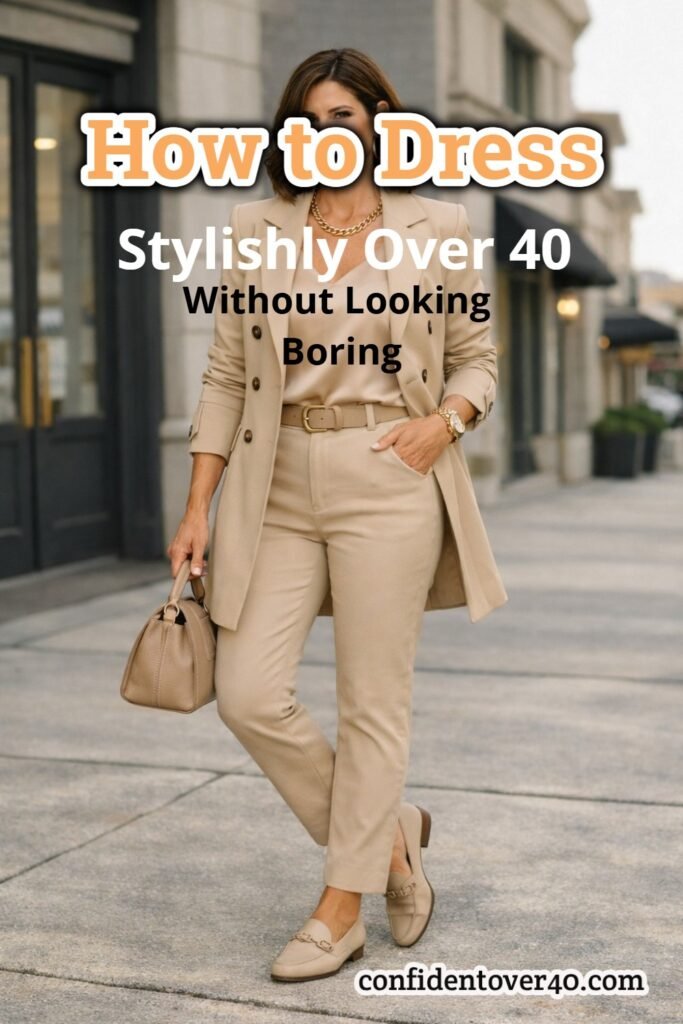
9. Monochrome Beige Outfit
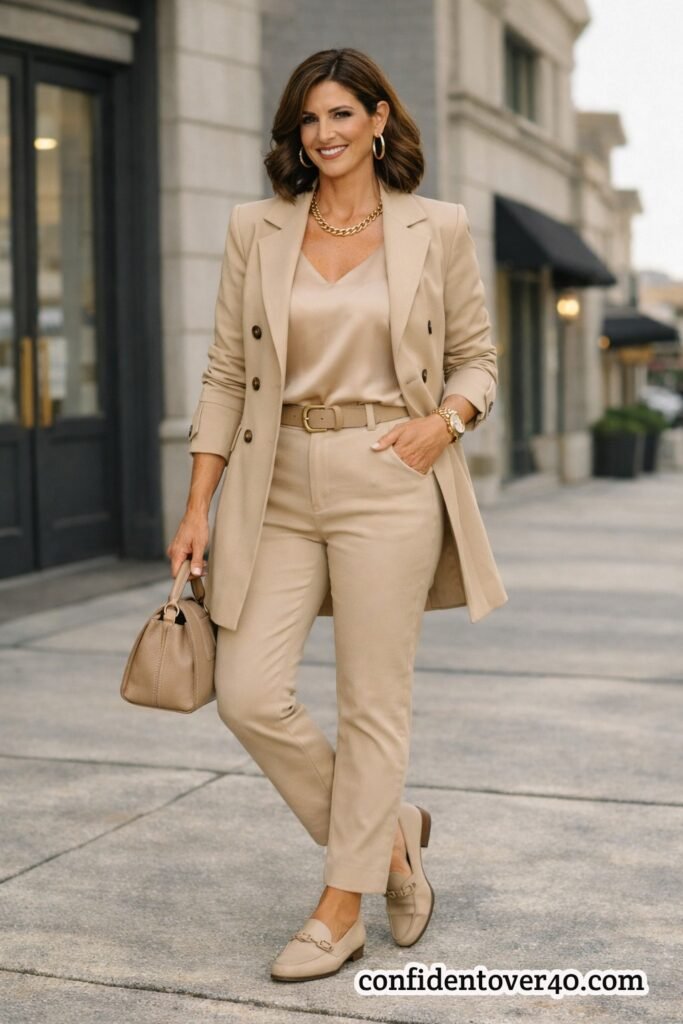
A neutral outfit feels elevated when the tones are layered.
10. Midi Dress and Denim Jacket
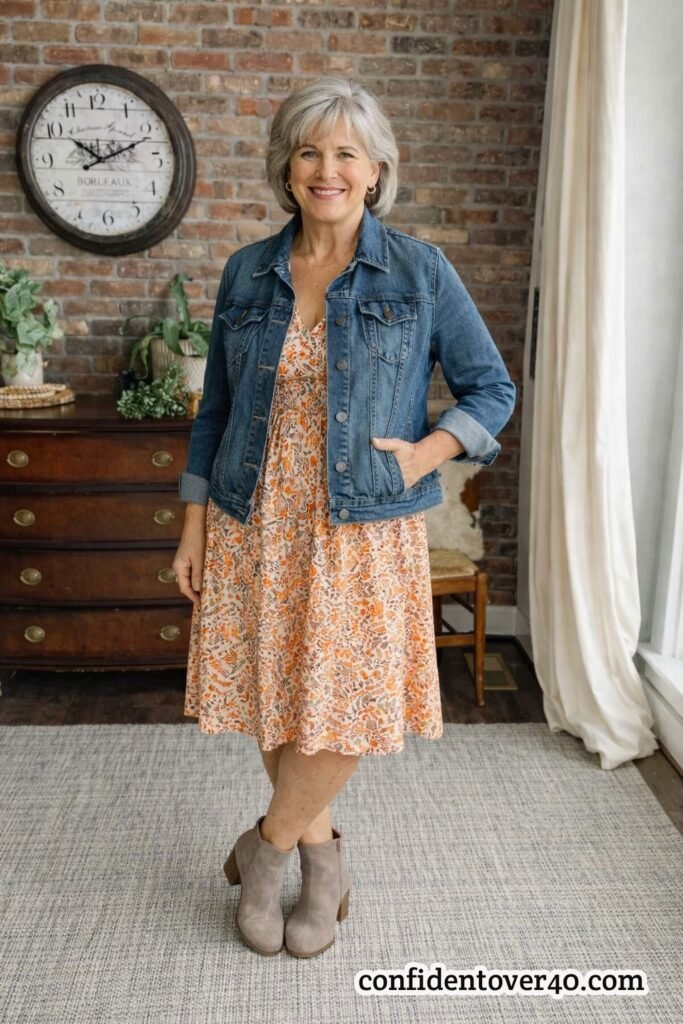
Comfortable, feminine, and easy for casual days.
Final Thoughts
Dressing stylishly over 40 without looking boring is all about thoughtful details. You can keep your wardrobe classic while still making it feel fresh, modern, and personal.